How to Read a Blood Sugar Supplement Label: Forms, %DV & Blends
| Start here | Check the serving size first — every amount is per serving, not per capsule. |
| %DV | Shows a nutrient’s share of a daily reference; over 100% is normal for many minerals. A dagger means “no DV established” (typical for herbs). |
| Forms | Look for the words in brackets — e.g. chromium as amino acid chelate — which signal absorbable, quality forms. |
| Blends | A proprietary blend discloses the total weight and ingredient order, not each dose. Legal and common; know the trade-off. |
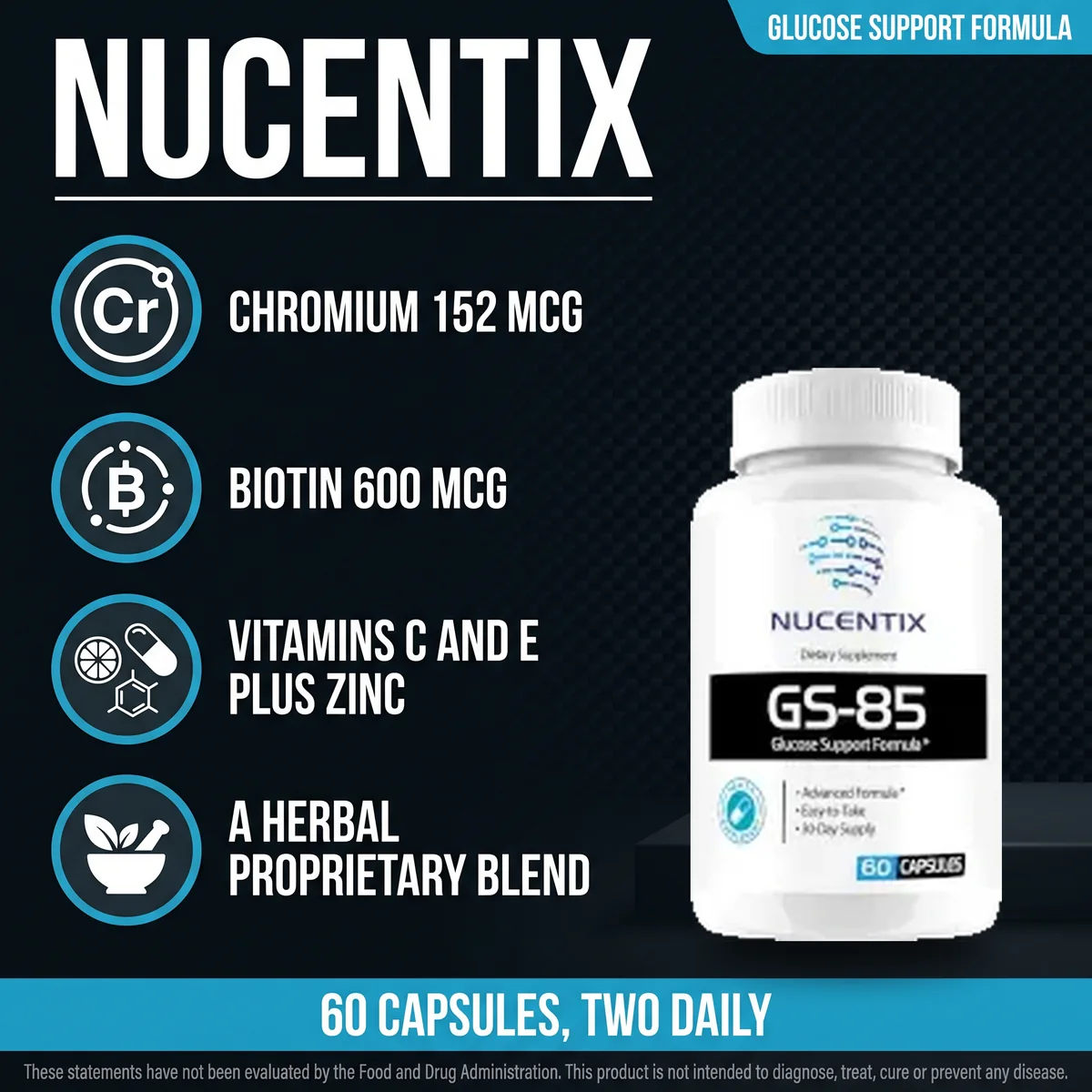
The blood-sugar aisle is crowded, and most of the products in it use the same buzzwords. The way to tell a serious formula from an empty one is not the marketing on the front — it is the Supplement Facts panel on the back. Learning how to read a blood sugar supplement label takes about ten minutes and pays off every time you shop. This guide walks through the panel line by line: serving size, % Daily Value, ingredient forms, proprietary blends, and the red flags that should make you put a bottle back on the shelf. We will use the real Nucentix GS-85 label as a running example so the numbers stay concrete.
Step 1: Find the serving size — it changes everything
Before you read a single ingredient amount, find the serving size, usually near the top of the panel. This is the single most misread line on any supplement. Every quantity below it — the milligrams, the micrograms, the % Daily Values — is calculated per serving, not per capsule or tablet. If a product’s serving size is two capsules and the label says 152 mcg of chromium, you only get 152 mcg when you take both capsules. A bottle with 60 capsules and a two-capsule serving is a 30-day supply, not 60 days. Get the serving size wrong and every comparison you make afterwards is off. Nucentix GS-85, for reference, uses a two-capsule daily serving and a 60-capsule bottle — a clean 30-day supply.
Step 2: Understand % Daily Value (%DV)
Next to many nutrients you will see a % Daily Value. The %DV compares the amount in one serving to a general daily reference intake set for the population. A few things surprise people here:
- ✓Over 100% is normal and usually safe for many vitamins and minerals in supplements. Chromium, for instance, is commonly listed well above 100% DV — GS-85 shows 434% for its 152 mcg.
- ✓A dagger (†) means no Daily Value has been established for that ingredient. This is standard for botanicals like cinnamon, gymnema and bitter melon, which do not have a population reference intake.
- ✓%DV is a reference, not a target ceiling. It helps you compare products, but it does not tell you the “right” dose for a specific goal.
If you want the deeper story on why chromium routinely lands in the hundreds of percent, our companion piece explains what chromium does for blood sugar and why the DV works the way it does for trace minerals.
Step 3: Read the ingredient forms in brackets
This is where quality quietly reveals itself. The same nutrient can appear in different chemical forms that the body absorbs to different degrees, and good labels name the specific form in brackets. A few to know in the glucose category:
- ✓Chromium (as amino acid chelate) or picolinate — absorbable organic forms, preferable to a cheap inorganic salt.
- ✓Vitamin E (as d-alpha tocopheryl) — the “d-” prefix indicates the natural form; “dl-” is synthetic.
- ✓Magnesium (as oxide, citrate, glycinate…) — forms differ in absorption and digestive comfort.
- ✓Alpha-lipoic acid — standard (racemic R/S) is well studied; some labels specify R-ALA.
When two products list the same number for a nutrient, the one that names a recognised, bioavailable form is giving you a better chance of actually using it. For the antioxidant example, see our breakdown of alpha-lipoic acid for blood sugar and the R-versus-S question.
A label built to be read
Nucentix GS-85 names its forms — chromium as an amino acid chelate, natural vitamin E — and lists its 12-herb blend openly. Two capsules a day, 60-day guarantee.
See Nucentix GS-85 PackagesStep 4: Make peace with the proprietary blend
Many glucose formulas group their botanicals into a proprietary blend — a single line that lists a total weight (say, a blend of guggul, bitter melon, licorice, cinnamon, gymnema, alpha-lipoic acid, banaba, yarrow, juniper, white mulberry, L-taurine and cayenne) followed by the individual herb names. Here is what a blend does and does not tell you:
- ✓It discloses the total weight of all the herbs combined.
- ✓It lists ingredients in order of predominance — the first-named herb is present in the greatest amount.
- ✓It does not disclose each herb’s exact milligrams. That is the trade-off, and it is legal and extremely common.
A proprietary blend is not automatically a warning sign; it protects a formula’s recipe and is used by many reputable brands. The judgment call is about trust: a transparent brand that lists its vitamins and minerals with exact amounts and discloses the full contents of its blend has earned more of it than one hiding everything behind a single mysterious number.
Step 5: Check the “other ingredients” and directions
Below the actives sits a smaller line called other ingredients — the capsule material, flow agents and fillers such as gelatin, rice flour, microcrystalline cellulose, magnesium stearate and silicon dioxide. These are normal in tiny amounts. This is also where dietary flags live: gelatin capsules are not vegetarian, for example. Finally, read the suggested use line so you know how and when to take the product — with food, twice daily, and so on — and match that to the serving size you found in Step 1.
Step 6: Learn the compliance language (and the red flags)
Legitimate supplement labels use “structure-function” language — phrases like “supports healthy blood sugar already within a normal range” — paired with the familiar disclaimer that the statements have not been evaluated by the FDA and the product is not intended to diagnose, treat, cure or prevent any disease. That wording is not a dodge; it is the law, and it is a sign the brand is playing by the rules. The genuine red flags are the opposite:
- ✓Disease claims — “cures diabetes,” “replaces insulin,” “lowers A1c guaranteed.” No supplement may legally claim these.
- ✓No forms, no amounts — a vague list of trendy names with nothing quantified.
- ✓A giant catch-all blend that hides every ingredient behind one number.
- ✓No manufacturer, address or contact details, and no mention of GMP manufacturing.
Pair this label skill with the fundamentals in how to support healthy blood sugar naturally, and you will be a far sharper shopper than most people in the aisle.
Know what you are buying
Now that you can read the panel, keep your routine consistent with the 3-bottle or 6-bottle package — the 6-bottle option is the best value and ships free in the U.S.
Order Nucentix GS-85† These statements have not been evaluated by the FDA. Nucentix GS-85 is not intended to diagnose, treat, cure or prevent any disease, and is not a treatment for diabetes. This article is for general information only and is not medical advice. If you take medication or manage a medical condition, talk to your doctor before starting any supplement.
Frequently asked questions
What should I check first on a blood sugar supplement label?
Start with the serving size, because every amount on the panel is per serving, not per capsule. A formula that lists 152 mcg of chromium per two-capsule serving is only giving you that amount if you take both capsules. Reading the rest of the label without checking the serving size can make a product look stronger or weaker than it is.
What does % Daily Value mean on a supplement?
The % Daily Value (%DV) tells you how much a nutrient contributes to a general daily reference intake. Numbers above 100% are common and safe for many vitamins and minerals in supplements; for example chromium is often listed well above 100% DV. Ingredients without an established Daily Value, such as most botanicals, will show a dagger symbol instead.
Is a proprietary blend a bad sign?
Not necessarily. A proprietary blend discloses the total weight of a group of ingredients and lists them in order of predominance, but not each individual amount. It is a legal, common practice that protects a formula’s recipe. The trade-off is less transparency on exact per-herb doses, so it comes down to trusting the brand and the quality of the overall formula.
Why does ingredient form matter on a label?
The same nutrient can appear in forms that differ in how well the body absorbs them. Chromium as an amino acid chelate or picolinate is more bioavailable than a cheap inorganic salt. Naming the specific form is a sign of a thoughtfully built product, so it is worth looking for the words in brackets after each ingredient.
What are red flags on a blood sugar supplement label?
Watch for disease claims like “cures” or “treats,” which are not allowed for supplements; vague ingredient lists with no forms or amounts; huge proprietary blends that hide everything behind one number; and missing manufacturing or contact details. Honest labels stick to structure-function language and disclose what is inside.
References
1. U.S. Food & Drug Administration — Dietary Supplement Labeling Guide. fda.gov/food/dietary-supplement-labeling-guide
2. U.S. Food & Drug Administration — How to Understand and Use the Nutrition Facts / Daily Values. fda.gov/food/daily-value-nutrition-and-supplement-facts-labels
3. National Institutes of Health, Office of Dietary Supplements — Dietary Supplements: What You Need to Know. ods.od.nih.gov/factsheets/WYNTK-Consumer
4. Federal Trade Commission — Health Products Compliance Guidance. ftc.gov/business-guidance/resources/health-products-compliance-guidance
About the Nucentix Research Team
The Nucentix Research Team is an independent group of nutrition and wellness writers on a mission to make supplement labels less intimidating. We read the regulations and the primary science, cite our sources, and keep our guidance general and traditional-use focused — never a stand-in for personalised medical advice. If this guide does its job, you will never again buy a blood-sugar supplement on the strength of the front of the bottle alone.