Bitter Melon Benefits for Blood Sugar: Charantin, Polypeptide-p & Dose
| What it is | Bitter melon (Momordica charantia) is a bitter gourd eaten across Asia and used for centuries in traditional medicine. |
| Why it helps blood sugar | It carries charantin and an insulin-like protein, polypeptide-p, that researchers study for their role in glucose handling. |
| How it works | Studied for supporting AMPK activity and GLUT4 transporters — helping cells use glucose rather than forcing levels down. |
| On the label | Best seen as one active in a balanced blend (with cinnamon, gymnema, banaba), not a lone megadose. |
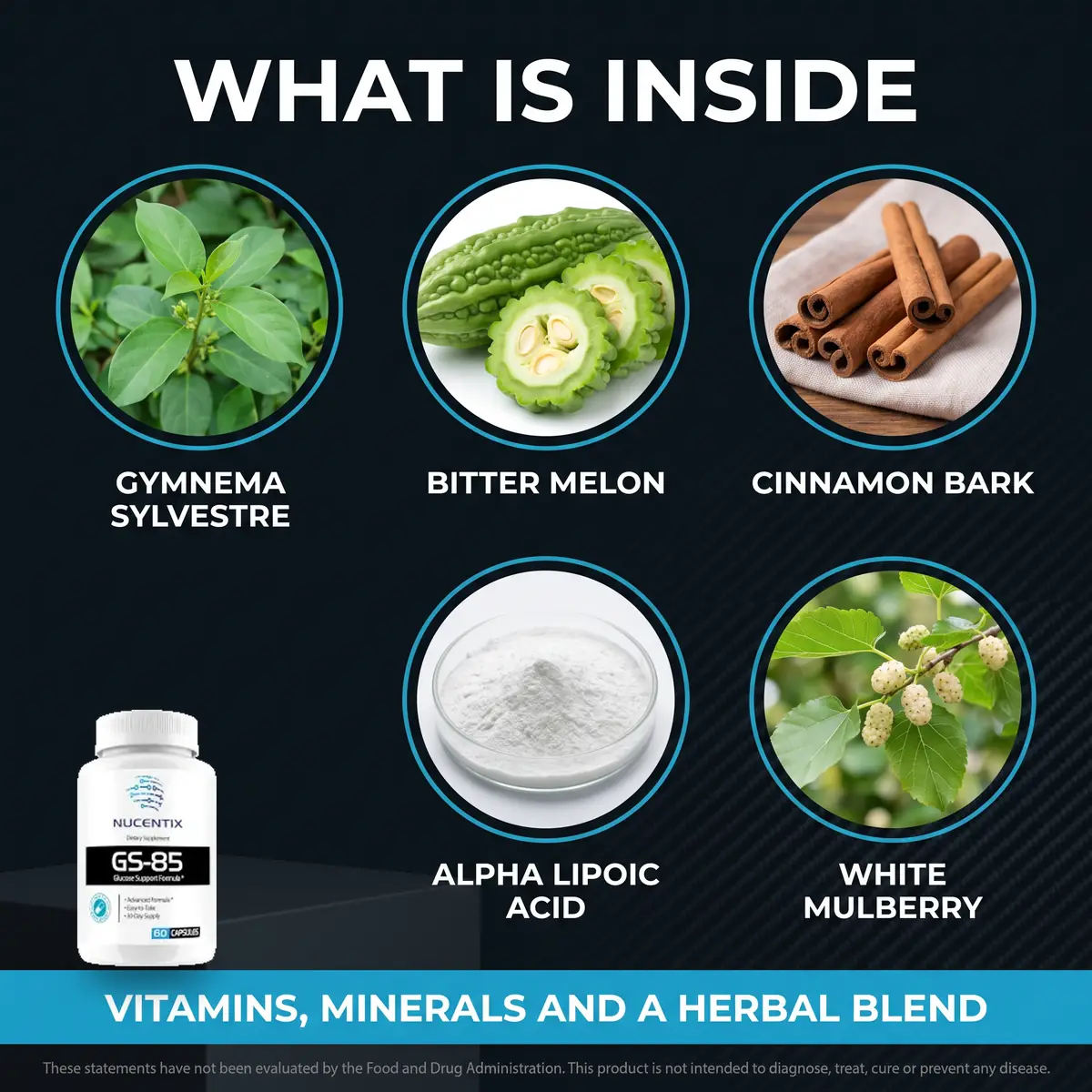
Bitter melon benefits for blood sugar are one of the oldest topics in herbal nutrition — long before there were capsules, cooks in India, China, the Philippines and East Africa were eating this knobbly green gourd precisely because it was believed to help the body handle sweetness. Today bitter melon shows up on the ingredient panels of many glucose-support formulas, including Nucentix GS-85, and the reason is not folklore alone. The plant carries a distinctive set of compounds — charantin, an insulin-like protein called polypeptide-p, and a glycoside called vicine — that scientists have been studying for decades. This guide explains what bitter melon actually is, the mechanisms researchers believe it works through, how much tends to be used, and how to judge it when you see it on a label.
What is bitter melon?
Bitter melon, known botanically as Momordica charantia, is a climbing vine in the gourd family that produces a warty, cucumber-shaped fruit with an unmistakably sharp, bitter taste. It goes by many names — bitter gourd, karela, balsam pear, goya — and it has a dual identity: it is both a vegetable, stir-fried and stuffed in kitchens across South and Southeast Asia, and a traditional remedy documented in Ayurvedic and Traditional Chinese Medicine texts. That food-and-medicine overlap matters, because it means bitter melon has an unusually long track record of everyday human use, not just laboratory attention.
The bitterness itself is a clue. Many of the plant compounds that give bitter melon its taste are the same ones researchers are interested in. In herbal traditions, bitter flavours are often linked with digestion and metabolism, and bitter melon is the classic example — its very name in several languages translates to something close to “bitter squash.”
The active compounds behind bitter melon’s reputation
When people ask why bitter melon has a place in blood-sugar formulas, the honest answer is that it is not a single magic molecule but a small cast of them working together. Three stand out.
Charantin
Charantin is not one chemical but a mixture of steroidal saponins found in the fruit. It is one of the most-cited actives in bitter melon research and has been studied for its role in glucose metabolism. Because charantin content varies with how the fruit is grown, harvested and extracted, standardised extracts aim to deliver a consistent amount rather than leaving it to chance.
Polypeptide-p (“plant insulin”)
The most intriguing compound is polypeptide-p, a plant protein whose structure resembles human insulin closely enough that it is sometimes nicknamed “plant insulin” or “p-insulin.” Researchers have studied it specifically because a naturally occurring, insulin-like molecule from a food plant is a genuinely unusual find. It is important to be precise and compliant here: this is an area of ongoing research, and the presence of an insulin-like protein does not make bitter melon a medicine or a substitute for insulin. It is simply one reason the plant has drawn so much scientific curiosity.
Vicine and other glycosides
Bitter melon seeds also contain vicine, a glycoside that has been examined in the blood-sugar context. Alongside these named compounds sit a broad range of polyphenols and antioxidants typical of a deeply coloured, bitter plant food.
How does bitter melon work for blood sugar?
This is the part most readers want in plain English. After a carbohydrate-containing meal, glucose enters the bloodstream and the body works to move it into cells where it can be burned for energy. Research into bitter melon has focused on a few points along that pathway.
First, several studies point to AMPK — an enzyme sometimes described as a cellular “energy sensor” — which, when active, encourages cells to take up and use glucose. Bitter melon compounds have been studied for their ability to support AMPK activity, interestingly through a pathway that overlaps with what happens during exercise. Second, researchers have looked at GLUT4, the glucose transporter that shuttles glucose from the blood into muscle and fat cells; some evidence suggests bitter melon may help more of these transporters reach the cell surface where they do their work. The practical theme across this research is consistent with how the best glucose-support botanicals behave: they are studied for helping the body use the glucose it already has, rather than acting like a drug that forces numbers down.
If you want the food-and-habit foundation that all of these actives are designed to complement, our companion guide on how to support healthy blood sugar naturally covers the everyday moves — fibre, protein, post-meal walks — that do the heavy lifting.
Bitter melon, in a balanced daily blend
Nucentix GS-85 pairs bitter melon with cinnamon, gymnema, banaba and chromium in one twice-daily capsule — a focused glucose-support routine backed by a 60-day guarantee.
See Nucentix GS-85 PackagesTraditional use vs modern supplements
For most of its history bitter melon was consumed as food or as a fresh juice — a genuinely bitter experience that not everyone enjoys. Traditional preparations used the whole fruit, the juice, or dried powder. Modern supplements changed the format in two ways. They concentrate the plant into a standardised extract so the dose is consistent from capsule to capsule, and they combine bitter melon with complementary actives so no single ingredient has to do all the work.
That second point is the more important one. Bitter melon is rarely the star of a well-built formula; it is a supporting player. In Nucentix GS-85, for example, bitter melon sits inside a 12-herb blend beside cinnamon bark and gymnema sylvestre, the “sugar destroyer”, plus trace minerals like chromium and antioxidants such as alpha-lipoic acid. Each targets a slightly different part of the glucose story, which is exactly what you want from a thoughtfully designed product.
How much bitter melon is in a supplement?
There is no single “correct” number, and any label that implies otherwise should make you cautious. Because extracts vary in strength — a standardised extract can be many times more concentrated than raw dried fruit — the microgram or milligram figure only means something when you know the extract ratio and what it is standardised to. This is one reason bitter melon usually appears as a measured part of a blend rather than as a lone high-dose capsule.
When you compare products, look past the raw number to the quality signals: Is the botanical named clearly (Momordica charantia), and is the plant part specified (fruit)? Is it part of a coherent blend rather than a random grab-bag? And is the serving size honest and transparent? For a full walk-through of decoding these panels, see our guide on how to read a blood sugar supplement label.
What to look for on the label
- ✓Botanical name and plant part — “Bitter Melon (Momordica charantia, fruit)” is more transparent than a vague “bitter gourd extract.”
- ✓Part of a sensible blend — paired with recognised actives like cinnamon, gymnema, banaba and chromium.
- ✓Honest serving size — clear amounts per serving rather than a mystery “proprietary blend” with no numbers.
- ✓Clean manufacturing — made in a GMP-registered facility, non-GMO, with quality seals you can verify.
Safety, taste and who should be cautious
Because bitter melon is eaten as a vegetable across much of the world, it has a reassuring history of food use. In supplement form it is generally well tolerated, though the plant’s natural bitterness and its seed compounds mean a few groups should be careful. Anyone who is pregnant or nursing should avoid concentrated bitter melon extracts. Anyone already taking blood-sugar-lowering medication should speak to their doctor first, since combining actives that both influence glucose can stack effects. And as with any supplement, bitter melon is not a treatment for diabetes or any disease — it is a traditional botanical studied for supporting healthy blood sugar that is already in a normal range.
Make bitter melon part of your daily routine
The 3-bottle and 6-bottle packages keep you consistent so you never pause mid-routine — the 6-bottle option is the best value and ships free in the U.S.
Order Nucentix GS-85† These statements have not been evaluated by the FDA. Nucentix GS-85 is not intended to diagnose, treat, cure or prevent any disease, and is not a treatment for diabetes. This article is for general information only and is not medical advice. If you have a medical condition or take medication, talk to your doctor before starting any supplement.
Frequently asked questions
What are the benefits of bitter melon for blood sugar?
Bitter melon (Momordica charantia) has a long traditional use in Ayurvedic and Asian medicine for supporting healthy blood sugar. It contains plant compounds such as charantin and an insulin-like protein called polypeptide-p that researchers have studied for their role in glucose handling, which is why bitter melon appears in many modern glucose-support blends.
What are the active compounds in bitter melon?
The three most-studied actives are charantin (a steroidal saponin mixture), polypeptide-p (a plant protein with an insulin-like structure, sometimes called plant insulin), and vicine. These compounds are the reason bitter melon is a fixture in traditional blood-sugar preparations.
How does bitter melon work in the body?
Research suggests bitter melon may support the activity of AMPK, an enzyme involved in moving glucose into cells, and may help GLUT4 glucose transporters reach the cell surface. In plain terms, it is studied for helping the body use the glucose already in the bloodstream rather than forcing levels down like a drug.
How much bitter melon is used in supplements?
Amounts vary widely because extracts differ in strength. Bitter melon is often included as one active in a broader glucose-support blend rather than as a standalone megadose. In Nucentix GS-85 it sits alongside cinnamon, gymnema, banaba and other botanicals in a measured two-capsule serving.
Is bitter melon safe to take every day?
Bitter melon is eaten as a vegetable across Asia and has a long history of food and traditional use. As with any supplement, it is not a treatment for any disease, and anyone who is pregnant, nursing, taking blood-sugar medication or managing a health condition should speak to a doctor before using a concentrated extract.
References
1. National Center for Complementary and Integrative Health (NCCIH) — Bitter Melon. nccih.nih.gov/health/bitter-melon
2. National Library of Medicine, PubMed — Momordica charantia and diabetes research overview. pubmed.ncbi.nlm.nih.gov
3. Memorial Sloan Kettering Cancer Center, About Herbs — Bitter Melon. mskcc.org/integrative-medicine/herbs/bitter-melon
4. Oregon State University, Linus Pauling Institute — Micronutrient Information Center. lpi.oregonstate.edu/mic
About the Nucentix Research Team
The Nucentix Research Team is an independent group of nutrition and wellness writers who review the science behind common blood-sugar ingredients and translate it into plain language. We read the primary sources, cite them openly, and keep our guidance general and traditional-use focused — never a substitute for personalised medical advice. Our aim is simple: help you become a sharper label-reader so your money goes toward formulas that are actually built to support healthy, everyday glucose metabolism.