What Does Magnesium Do for Blood Sugar? Dose, Forms & Label Guide
| What it is | Magnesium is an essential mineral involved in more than 300 enzyme reactions, including those that handle glucose. |
| What it does for blood sugar | It works as a cofactor in glucose metabolism and helps cells respond to insulin — the hormone that clears glucose from the blood. |
| How much | The adult RDA is about 310–420 mg/day; the label Daily Value is 420 mg. Most should come from food. |
| On the label | Prefer an absorbable form — glycinate, citrate or malate — over cheap, poorly used magnesium oxide. |
What does magnesium do for blood sugar? In one sentence: magnesium is the quiet workhorse mineral your cells need in order to burn carbohydrate for energy and to hear insulin’s message clearly. It is not a stimulant and it is not a drug, but it sits inside so many steps of glucose metabolism that a shortfall can make the whole system run less smoothly. This guide explains what magnesium actually is, the mechanism researchers believe connects magnesium and blood sugar, how much you need each day, and how to read the mineral on a supplement label so you are not paying for a form your body can barely use. It pairs naturally with our companion pieces on what chromium does for blood sugar and whether zinc helps with blood sugar, because these minerals tend to be discussed together.
Magnesium is a major mineral — here is what that means
Nutrition splits minerals into two buckets. Trace minerals like chromium and zinc are needed in micrograms or a few milligrams. Major minerals — and magnesium is one — are needed in hundreds of milligrams a day. That difference matters, because it tells you magnesium is doing a lot of structural, everyday work rather than acting in tiny catalytic bursts. In fact, magnesium is a cofactor in more than 300 enzyme systems that regulate protein synthesis, muscle and nerve function, energy production and, most relevant here, the metabolism of glucose.
Your body holds roughly 25 grams of magnesium, most of it locked in bone and soft tissue, with only about one percent circulating in the blood. That is one reason a routine blood test can look normal even when tissue stores are running low: the blood level is tightly defended and does not always reflect what is happening inside cells. For a mineral this widely used, keeping intake steady is simply good housekeeping for metabolic health.
What does magnesium do for blood sugar? The mechanism, in plain English
Here is the part most people actually want. After a meal, carbohydrate is broken down into glucose and enters the bloodstream. The pancreas releases insulin, a hormone that acts like a key, unlocking cells so glucose can move out of the blood and into the tissues that use it for fuel. Magnesium shows up at more than one point in that story.
Magnesium and insulin signalling
Insulin does its job by docking onto a receptor on the cell surface, which switches on a cascade of internal signals. Several of the enzymes in that cascade — the kinases that pass the message along — depend on magnesium to function. Magnesium also helps move glucose across the cell membrane and into the energy-producing machinery inside. When magnesium is plentiful, insulin’s message tends to be heard clearly; when it is scarce, researchers have described the signal as running less efficiently. This is why magnesium is so often grouped with insulin sensitivity in the scientific literature.
The two-way street between magnesium and glucose
There is an interesting feedback loop worth understanding. Not only does magnesium influence how the body handles glucose, but the way the body handles glucose can influence magnesium. When blood sugar runs high over time, the kidneys tend to flush more magnesium out in urine, which can nudge stores lower — which in turn can make the signalling less efficient. Observational research has repeatedly found that people with higher magnesium intakes tend to have a lower likelihood of blood-sugar problems, though association is not the same as proof, and no single nutrient is a cure for anything. The practical takeaway is simply that keeping magnesium topped up supports the machinery your body already uses to keep glucose steady — within a normal, healthy range.
How much magnesium do you actually need?
Unlike chromium, magnesium has a full Recommended Dietary Allowance (RDA). For adults it lands at roughly 310 to 320 mg per day for women and 400 to 420 mg per day for men, rising a little in pregnancy. The Daily Value used on supplement labels is 420 mg, so a magnesium line reading, say, 100 mg would be listed as about 24% DV. Most of that intake is meant to come from food; supplements usually provide a partial top-up rather than a full day’s requirement, which is sensible because very large single doses of poorly absorbed magnesium mostly produce a laxative effect. As always, if you take medication or manage a health condition — kidney issues in particular — confirm the dose with your doctor first.
A focused daily glucose-support routine
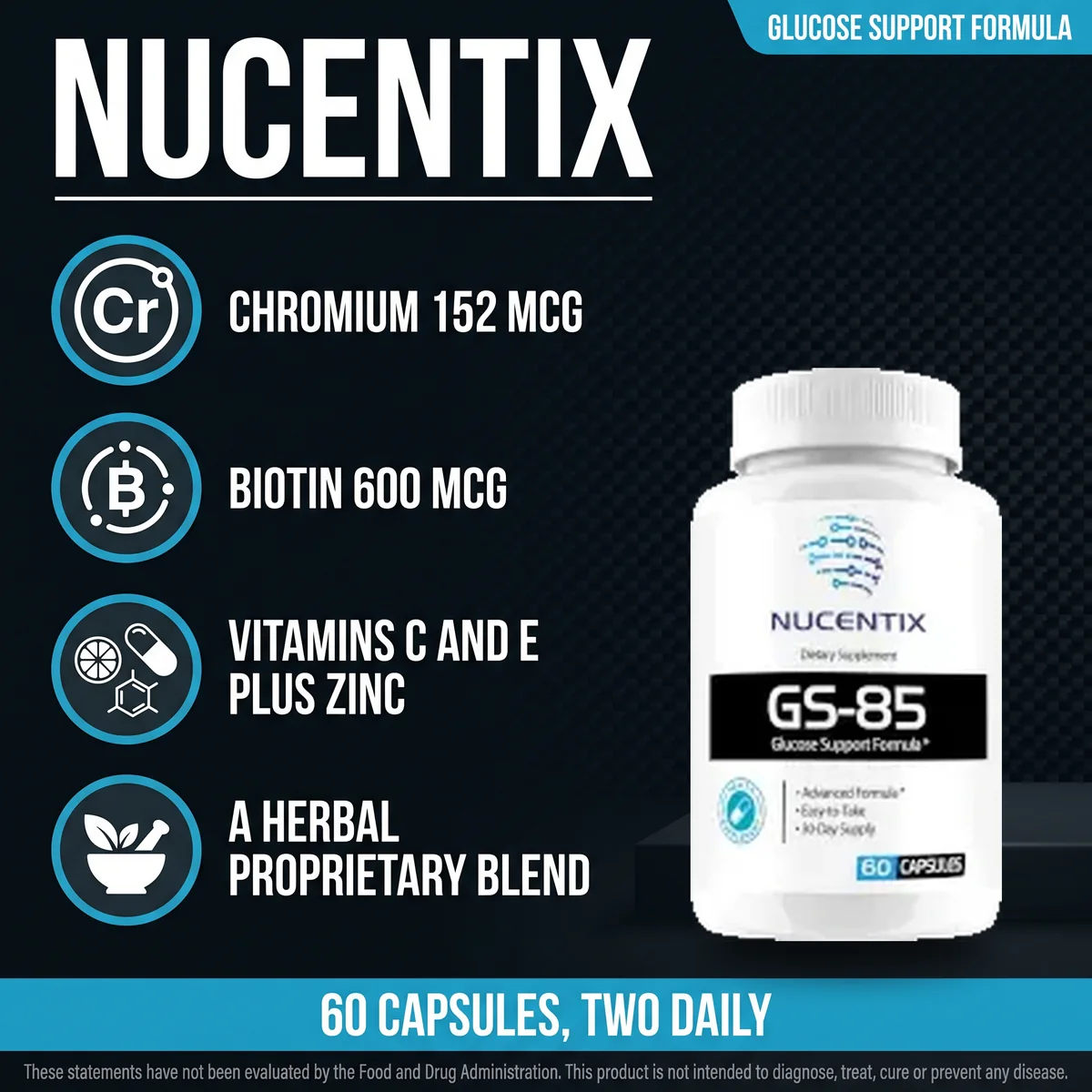
Nucentix GS-85 pairs 152 mcg of chromium and 600 mcg of biotin with cinnamon, gymnema, bitter melon and more — a two-capsule routine you can build your mineral-rich meals around, backed by a 60-day guarantee.
See Nucentix GS-85 PackagesMagnesium forms on a label: glycinate vs citrate vs oxide
This is where label-reading pays off, because the form of magnesium changes how much your body actually absorbs and how it sits with your stomach. Elemental magnesium is always bound to a carrier, and that carrier makes the difference:
- ✓Magnesium glycinate (bisglycinate) — bound to the amino acid glycine. Well absorbed and gentle on digestion, which is why it is a popular everyday choice.
- ✓Magnesium citrate — bound to citric acid. Good absorption and widely available; larger doses can loosen stools.
- ✓Magnesium malate — bound to malic acid. Another absorbable organic form some people favour for daytime use.
- ✓Magnesium oxide — cheap and high in elemental magnesium by weight, but poorly absorbed and more likely to act as a laxative. A common filler form to be wary of when it is the only magnesium listed.
The lesson mirrors what we say about minerals generally: when two products list the same milligram number, the one using a recognised, absorbable organic form is giving you a better shot at actually using what you paid for. The same instinct applies right across a supplement facts panel — our full walkthrough of how to read a blood sugar supplement label shows how to apply it line by line.

Who tends to run low on magnesium?
Magnesium is found in leafy greens like spinach and Swiss chard, in pumpkin and chia seeds, almonds and cashews, black beans and edamame, whole grains, and even dark chocolate. The problem is that modern refining strips magnesium out: white flour loses the bulk of the magnesium that was in the whole grain, and diets heavy in ultra-processed foods tend to be low in it precisely when the body is being asked to process the most refined carbohydrate. Heavy sweating, high alcohol intake, certain medications and simply getting older can also nudge needs upward. None of this is a diagnosis; it is context for why a measured daily amount, on top of a magnesium-friendly plate, appeals to many adults who want steady support.
Where magnesium fits alongside chromium and the botanicals
The most useful way to think about magnesium is as part of the foundation — the mineral bedrock that a glucose-support routine sits on top of. It works best stacked with the fundamentals: protein and fibre at meals, a short walk after eating, decent sleep, and the other actives that target glucose from different angles. In a formula like Nucentix GS-85, the spotlight is on chromium, biotin and a botanical blend of cinnamon, gymnema sylvestre and bitter melon, with antioxidant support from vitamins C and E. Magnesium, ideally from a mineral-rich diet or a gentle top-up, complements that stack rather than competing with it. Each nutrient plays a different, complementary role — which is exactly what you want from a well-built daily routine.

Make daily support a habit
The 3-bottle and 6-bottle packages keep you consistent so you never pause mid-routine — the 6-bottle option is the best value and ships free in the U.S.
Order Nucentix GS-85† These statements have not been evaluated by the FDA. Nucentix GS-85 is not intended to diagnose, treat, cure or prevent any disease, and is not a treatment for diabetes. This article is for general information only and is not medical advice. If you have a medical condition or take medication, talk to your doctor before starting any supplement.
Frequently asked questions
What does magnesium do for blood sugar?
Magnesium is an essential mineral that acts as a cofactor in the enzymes that metabolise glucose and in the insulin-signalling pathway. In plain terms, cells rely on magnesium to respond properly to insulin, which is the hormone that moves glucose out of the blood. That is why magnesium is a common ingredient to look for in glucose-support routines and why food sources of it matter for everyday metabolic health.
How much magnesium do I need each day?
The Recommended Dietary Allowance for adults is roughly 310 to 320 mg a day for women and 400 to 420 mg a day for men, and the Daily Value used on supplement labels is 420 mg. Most of that is meant to come from food; supplements typically add a partial top-up rather than a full day’s worth.
Which form of magnesium is best absorbed?
Organic, chelated forms such as magnesium glycinate, citrate and malate are generally better absorbed and gentler on digestion than magnesium oxide, which is cheap but poorly utilised and more likely to cause loose stools. When two labels list the same milligram number, the more absorbable form gives you a better return.
Can I get enough magnesium from food?
Yes, in principle. Leafy greens, nuts, seeds, legumes, whole grains and dark chocolate are all good sources. The catch is that refined, processed diets are often low in magnesium, so many adults fall short of the recommended intake and choose to add a measured amount from a supplement.
Does magnesium replace diet and exercise for blood sugar?
No. Magnesium is a supporting nutrient, not a substitute for the fundamentals. Balanced meals, fibre, movement, sleep and stress management do the heavy lifting; magnesium and other actives are designed to complement those habits, not replace them, and they support blood sugar that is already within a healthy range.
References
1. National Institutes of Health, Office of Dietary Supplements — Magnesium Fact Sheet for Health Professionals. ods.od.nih.gov/factsheets/Magnesium-HealthProfessional
2. Oregon State University, Linus Pauling Institute, Micronutrient Information Center — Magnesium. lpi.oregonstate.edu/mic/minerals/magnesium
3. Harvard T.H. Chan School of Public Health, The Nutrition Source — Magnesium. nutritionsource.hsph.harvard.edu/magnesium
4. National Institutes of Health, Office of Dietary Supplements — Chromium Fact Sheet for Health Professionals. ods.od.nih.gov/factsheets/Chromium-HealthProfessional
About the Nucentix Research Team
The Nucentix Research Team is an independent group of nutrition and wellness writers who review the science behind common blood-sugar ingredients and translate it into plain language. We read the primary sources, cite them openly, and keep our guidance general and traditional-use focused — never a substitute for personalised medical advice. Our aim is simple: help you become a sharper label-reader so your money goes toward formulas that are actually built to support healthy, everyday glucose metabolism.