Vitamins C and E for Blood Sugar: The Antioxidant Angle & Label Guide
| What they are | Vitamin C (ascorbic acid) and vitamin E (tocopherols) are two of the body’s key dietary antioxidants. |
| What they do for blood sugar | They help defend cells against oxidative stress — the wear-and-tear that busy glucose metabolism can generate — rather than lowering blood sugar directly. |
| How much | Daily Values are 90 mg for vitamin C and 15 mg for vitamin E; most can come from produce, nuts and seeds. |
| On the label | For vitamin E, prefer natural d-alpha-tocopherol over synthetic dl-; check the percent DV so it is meaningful, not token. |
Vitamins C and E for blood sugar are best understood not as glucose-lowering agents but as the antioxidant back-up team — the nutrients that help your cells clean up after the everyday chemistry of turning food into energy. If you have scanned the supplement facts panel on a glucose formula and wondered why two familiar vitamins sit beside minerals like chromium and zinc, this guide explains the logic. We will cover what these antioxidant vitamins actually do, the oxidative-stress mechanism that links them to glucose metabolism, how much you need, and how to read them on a label — including the small print that separates a natural vitamin E from a cheaper synthetic one. It complements our mineral guides on chromium and zinc, and our deep dive into alpha-lipoic acid, the antioxidant most associated with glucose support.
Antioxidants and oxidative stress, in one minute
Every cell runs on chemical reactions, and many of those reactions throw off unstable molecules called free radicals — atoms with an unpaired electron that will grab one from whatever is nearby, damaging fats, proteins and DNA in the process. Your body produces its own defences, but it also relies on dietary antioxidants to help mop up. When the balance tips — too many free radicals, not enough neutralising capacity — scientists call the result oxidative stress. Vitamins C and E are two of the front-line dietary antioxidants that keep that balance in check, which is why they appear in so many wellness formulas across categories.
What do vitamins C and E do for blood sugar? The mechanism
Here is the honest, compliant framing: vitamins C and E are not studied as blood-sugar-lowering ingredients the way chromium or certain botanicals are. Their role in a glucose formula is protective and complementary. Metabolising large amounts of glucose is metabolically busy work, and busy metabolism is one of the situations that can generate free radicals. By reinforcing the body’s antioxidant defences, vitamins C and E help cells cope with that everyday oxidative load. Think of them less as the engine and more as the oil that keeps the engine from wearing prematurely.
Vitamin E: the membrane guard
Vitamin E is fat-soluble, so it tucks into the fatty membranes that wrap every cell and stops a chain reaction of oxidative damage before it spreads through the membrane. That membrane-protecting job is its signature role and the reason it is grouped with cardiovascular and metabolic wellness so often.
Vitamin C: the water-phase antioxidant that also recycles vitamin E
Vitamin C is water-soluble, so it works in the watery compartments — inside cells, in blood plasma — where fat-soluble vitamin E cannot reach. Crucially, the two cooperate: after vitamin E neutralises a free radical it becomes temporarily “used up,” and vitamin C can help regenerate it back to its active form. This teamwork is exactly why the pair is more powerful together than either is alone, and why you often see them listed side by side.
How much vitamin C and vitamin E do you need?
Both have full recommended intakes. For vitamin C, adults need roughly 75 to 90 mg per day (a little more for smokers), and the label Daily Value is 90 mg. For vitamin E, the recommended intake is about 15 mg per day of alpha-tocopherol, which is the Daily Value too — historically expressed as around 22 IU of the natural form. Most people can hit these numbers from food: citrus, kiwi, peppers, broccoli and strawberries for vitamin C; almonds, sunflower seeds, wheat germ and vegetable oils for vitamin E. In a supplement, a sensible glucose formula uses these vitamins at supportive levels rather than mega-doses, because with antioxidants more is not automatically better — and fat-soluble vitamin E in particular has an upper limit worth respecting. As always, check with your doctor before adding high-dose vitamins if you take medication.
Antioxidant support, built into the daily routine
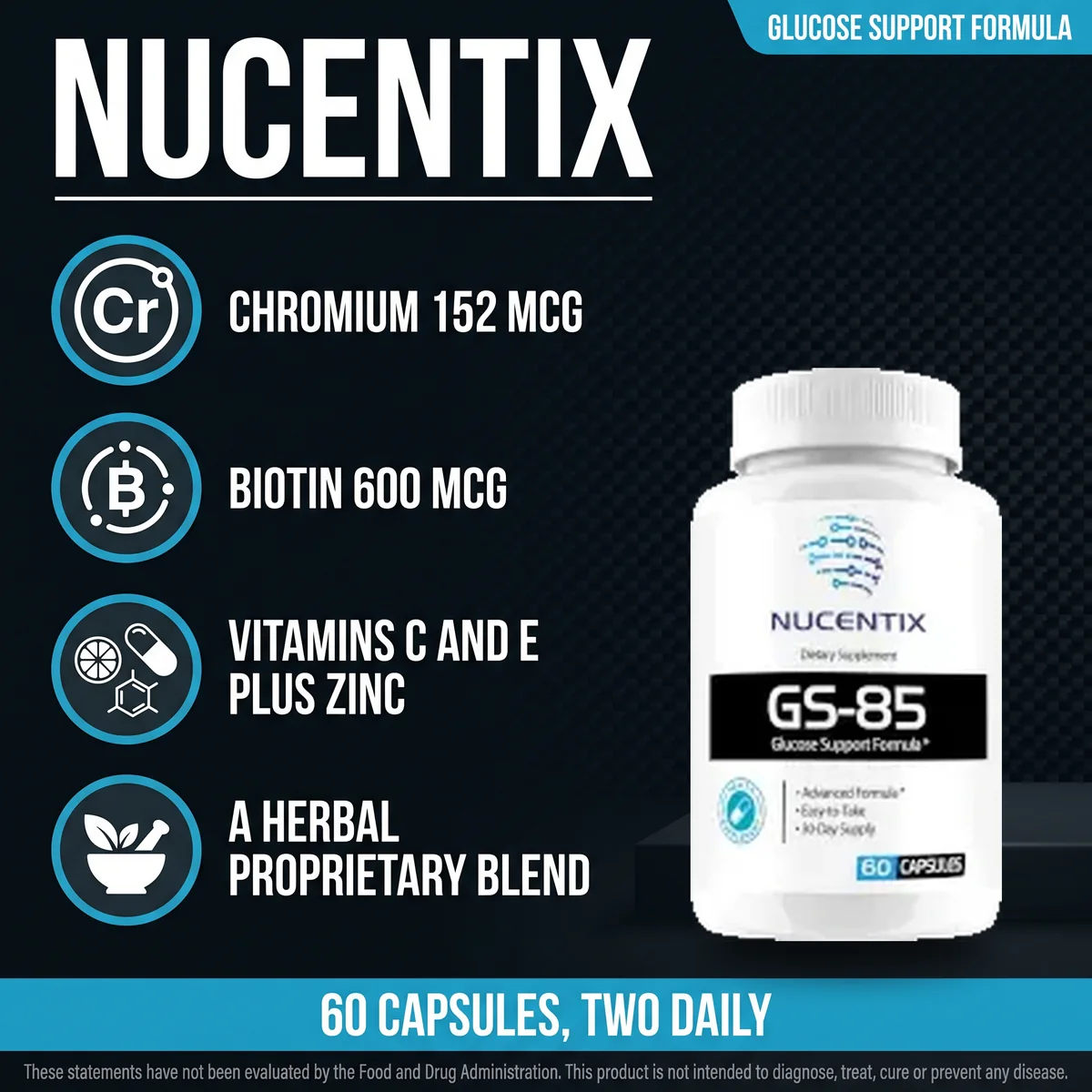
Nucentix GS-85 layers vitamins C and E and alpha-lipoic acid onto its chromium, biotin and 12-herb blend — a two-capsule daily routine designed to support glucose metabolism from several angles at once, backed by a 60-day guarantee.
See Nucentix GS-85 PackagesNatural vs synthetic vitamin E: the label detail that matters
This is where a careful eye pays off, because vitamin E is one of the few nutrients where the source genuinely changes the value you get:
- ✓Natural vitamin E (d-alpha-tocopherol) — the form your body prefers and uses most efficiently. The single-letter d prefix is the tell.
- ✓Synthetic vitamin E (dl-alpha-tocopherol) — a lab-made mix of forms, only some of which the body uses well, so it is less potent milligram for milligram. The dl prefix flags it.
- ✓Mixed tocopherols — some premium products include the wider tocopherol family for broader coverage, closer to how vitamin E appears in food.
For vitamin C, the practical questions are simpler: is a meaningful amount present (not a token dusting), and is the percent Daily Value shown so you can judge it at a glance? These are exactly the habits we teach in our full walkthrough of how to read a blood sugar supplement label — the same discipline applied to vitamins instead of botanicals.
Food first, supplement second
It is worth repeating the theme that runs through everything we write: food does the foundational work. A plate that is genuinely colourful — leafy greens, peppers, berries, citrus, a handful of nuts and seeds — delivers vitamins C and E together with fibre, potassium and a whole orchestra of plant compounds that no capsule fully replicates. A supplement’s job is to top up the gaps and concentrate a few targeted actives, not to excuse a beige diet. When the vitamins in a glucose formula are paired with real meals and the everyday habits in our guide to supporting healthy blood sugar naturally, they are doing exactly what they were designed to do.
Support your routine, day after day
The 3-bottle and 6-bottle packages keep you consistent so you never pause mid-routine — the 6-bottle option is the best value and ships free in the U.S.
Order Nucentix GS-85† These statements have not been evaluated by the FDA. Nucentix GS-85 is not intended to diagnose, treat, cure or prevent any disease, and is not a treatment for diabetes. This article is for general information only and is not medical advice. If you have a medical condition or take medication, talk to your doctor before starting any supplement.
Frequently asked questions
What do vitamins C and E do for blood sugar?
Vitamins C and E are antioxidants. They help neutralise reactive molecules called free radicals, and metabolising glucose is one of the processes that generates those molecules. By supporting the body’s defences against oxidative stress, the two vitamins are included in many glucose-support formulas as complementary protection rather than as blood-sugar-lowering agents themselves.
How much vitamin C and vitamin E do I need?
The Daily Value for vitamin C is 90 mg and for vitamin E is 15 mg (about 22 IU of the natural form). Recommended intakes for adults are roughly 75 to 90 mg of vitamin C and 15 mg of vitamin E per day, most of which can come from fruit, vegetables, nuts and seeds.
Why are vitamins C and E paired together?
They work as a team. Vitamin E is fat-soluble and protects cell membranes, while vitamin C is water-soluble and works in the watery parts of cells and blood. Vitamin C can also help regenerate used-up vitamin E, so pairing them gives broader antioxidant coverage than either alone.
What is the difference between natural and synthetic vitamin E?
Natural vitamin E is labelled d-alpha-tocopherol, while the synthetic form is dl-alpha-tocopherol. The natural d-form is more biologically active, so a smaller amount delivers the same benefit. On a label, the small d versus dl prefix is the tell.
Do vitamins C and E replace diet and exercise for blood sugar?
No. They are supporting antioxidant nutrients, not a substitute for the fundamentals. Balanced meals, colourful produce, movement, sleep and stress management do the heavy lifting; vitamins C and E complement those habits and support blood sugar that is already within a healthy range.
References
1. National Institutes of Health, Office of Dietary Supplements — Vitamin C Fact Sheet for Health Professionals. ods.od.nih.gov/factsheets/VitaminC-HealthProfessional
2. National Institutes of Health, Office of Dietary Supplements — Vitamin E Fact Sheet for Health Professionals. ods.od.nih.gov/factsheets/VitaminE-HealthProfessional
3. Oregon State University, Linus Pauling Institute, Micronutrient Information Center — Vitamin E. lpi.oregonstate.edu/mic/vitamins/vitamin-E
4. Harvard T.H. Chan School of Public Health, The Nutrition Source — Antioxidants. nutritionsource.hsph.harvard.edu/antioxidants
About the Nucentix Research Team
The Nucentix Research Team is an independent group of nutrition and wellness writers who review the science behind common blood-sugar ingredients and translate it into plain language. We read the primary sources, cite them openly, and keep our guidance general and traditional-use focused — never a substitute for personalised medical advice. Our aim is simple: help you become a sharper label-reader so your money goes toward formulas that are actually built to support healthy, everyday glucose metabolism.